Listen, then find it
This device cannot read the words aloud, so they are shown instead.
Sight Words
Sight word games, played as bingo
Sight word bingo online: a word is called, your child finds it on the card. Built on the Dolch sight words schools have used since 1936, with nothing to install and no account.
How Sight Word Bingo Works
-
The Word Is Spoken, Not Shown
A word is read aloud and your child finds it on the card. That is the whole point: a sight word is one you know by looking at it, so printing it at the top of the screen would turn the game into matching two identical shapes and test nothing. Tap the speaker to hear it again. If a device has no voice the words are shown instead, and there is a switch to show them anyway.
-
A Line Wins
Four in a row on the big card, three on the small one, in any direction. That is where bingo ends everywhere it is written down. You can carry on to fill the whole card if you want to, and the game will tell you how you did.
-
Then Read the Line Back
Marking a square proves your child found a shape. Reading the four words out loud proves they know them. Every teacher's version of this game ends with that check and no online one does, so ours asks for it — and will read the line back to you if you want to hear it first.
-
A Wrong Tap Costs Nothing
Tapping the wrong square shakes it and nothing else happens. The word stays called and the hunt carries on. Scanning a card of words that all look a bit alike is exactly the thing being practised, and being sent back to the start for a slow scan is not practice.
-
One Group at a Time
Dolch published his words in six groups and schools still teach them a group at a time: 40 pre-primer, 52 primer, then 41, 47 and 41 for the first three grades, plus 95 picture nouns. Pick the one your child is on. A card that mixes pre-primer GO with third-grade TOGETHER is not a level of anything.
-
The Middle Square Is Free
On the small card, the middle square starts marked. It is on almost every bingo card ever printed, it gives a four-year-old a way into the grid, and it means the first line is always reachable. The big card has no middle square, so it has no free space.
-
These Are Not Words to Sound Out
A sight word is one a child is meant to know whole, on sight — THE, SAID, COME, WAS. Most cannot be sounded out and none can be drawn, which is why phonics does not work on them and why they get their own game. If your child is still sounding words out letter by letter, start with the phonics games instead.
More word games for kids
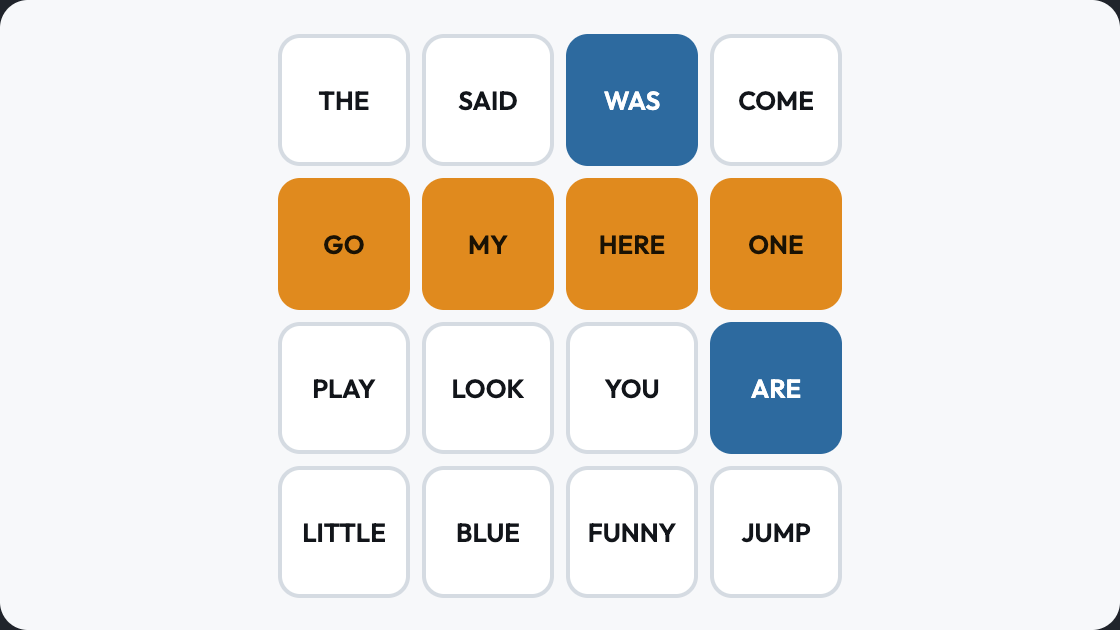 Sight Word Games
Sight word bingo on a four by four card: a word is called and your child finds it. Built on the Dolch sight words schools have set since 1936, for the words that cannot be sounded out.
Sight Word Games
Sight word bingo on a four by four card: a word is called and your child finds it. Built on the Dolch sight words schools have set since 1936, for the words that cannot be sounded out.
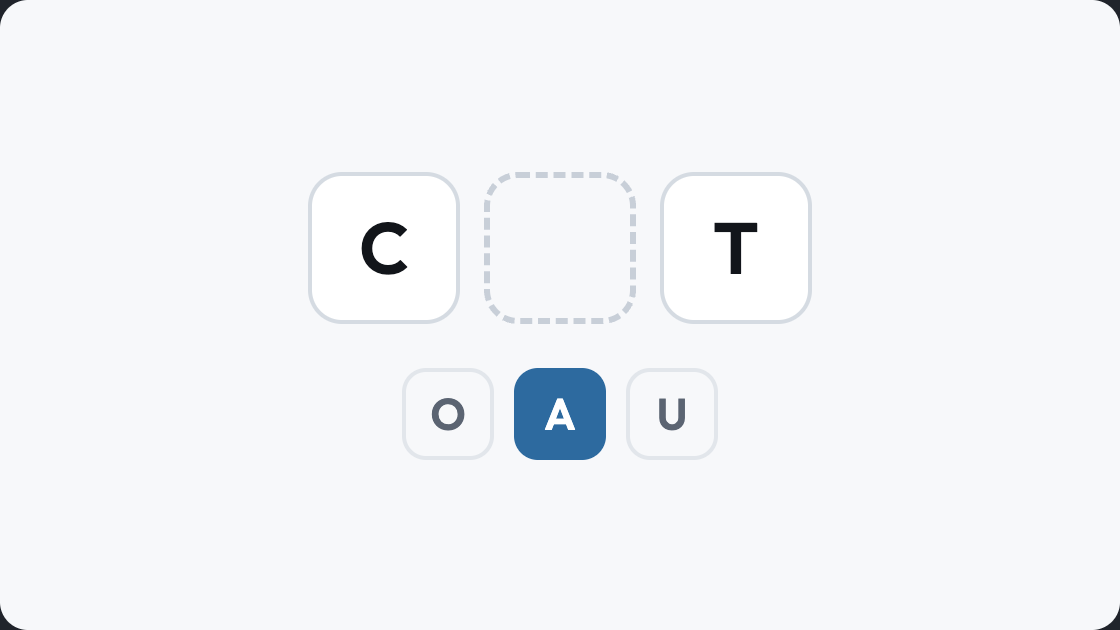 Phonics Games
Phonics games for children learning to read: sound out CVC words one letter at a time, with the missing sound to find. Phonics practice for kids that speaks the word aloud.
Phonics Games
Phonics games for children learning to read: sound out CVC words one letter at a time, with the missing sound to find. Phonics practice for kids that speaks the word aloud.
 Wordle for Kids
Wordle for kids, age-banded for five to thirteen at three to five letters. Word games for kids that stay inside vocabulary a child that age actually meets, with no ads during play.
Wordle for Kids
Wordle for kids, age-banded for five to thirteen at three to five letters. Word games for kids that stay inside vocabulary a child that age actually meets, with no ads during play.
Sight word questions, answered
What is a sight word?
A word a child is meant to recognise instantly, without working it out. Many break the usual rules — SAID, WAS, COME, ONE — so sounding them out gives the wrong answer. Reading fluently means knowing a few hundred by shape, and that is what sight word games are for: recognising, not decoding.
Which list do you use, Dolch or Fry?
Dolch, whole and unedited: all 220 service words and all 95 picture nouns, in the six groups he published them in. It is the older list and the shorter one, which makes it the one schools set for the first years of reading, and the one behind almost every dolch sight words game. The overlap is large: 91 of the first 100 fry sight words are on the Dolch list too, so a child working through this is covering most of that one as well.
Why is the word not written on the screen?
Because then it would not be a sight word game. If the word is printed above the card, a child who cannot read WOULD can still find the matching shape, and they have practised nothing. Every version of this game calls the word aloud for that reason. The text is there as a fallback for a device with no voice, and as a switch if you want it.
Why does the card change size on a phone?
Four columns on a small screen leave each word about sixty pixels wide, which puts BIRTHDAY on screen at twelve pixels. Three columns give ninety, and the word comes out the same size as this sentence. Three by three and four by four are both standard bingo cards, so nothing is lost by using the one that fits.
What age is this for?
Four to eight, broadly. Dolch is usually worked through from pre-school to about year three, a group at a time. There is nothing to read before you start, so a child who cannot yet read instructions can still play.
Can I use this for sight word practice online at school?
Yes. No account, no install, and no advertising during play. Every card and every group has its own address, so you can send a class to the same one, and there are two hundred cards in each group.
Do you have sight word bingo on paper?
Yes — the printables section has bingo cards and a call sheet for every Dolch group, which is how the game is usually played in a classroom. One caller, a set of different cards, and a counter on each square.